Introduction
Middle East war impact on LPG gas price in India is something many households rarely think about. India currently has more than 330 million LPG connections, and cooking gas is an essential part of daily life in almost every Indian kitchen.
However, a large portion of the LPG used in India comes from countries in the Middle East. Because of this dependency, geopolitical tensions and conflicts in the region can influence LPG supply and prices in India.
Whenever tensions rise between countries such as Iran, Israel, and the United States, the Middle East war impact on LPG gas price in India becomes visible through higher transportation costs, supply chain disruptions, and rising import prices.
Let’s understand how the LPG supply system works and why geopolitical conflicts in the Middle East can affect gas cylinder prices in India.
Where Does India’s LPG Come From?
Many people assume that the LPG used in Indian households is produced entirely within the country. In reality, India cannot meet its entire LPG demand through domestic production.
India’s LPG supply can be broadly divided into two parts.
Domestic Production (Around 40%)
Approximately 40% of India’s LPG demand is fulfilled domestically.
Major Indian oil companies produce LPG as a by-product during crude oil refining. These companies include:
- Indian Oil Corporation (Indane)
- Bharat Petroleum (Bharat Gas)
- Hindustan Petroleum (HP Gas)
However, this domestic production is not enough to meet the country’s growing demand for LPG.
Imported LPG (Around 60%)
To meet the remaining 60% of LPG demand, India relies heavily on imports from Middle Eastern countries such as:
- Qatar
- Saudi Arabia
- United Arab Emirates
- Kuwait
Because India depends significantly on these countries for LPG supply, the Middle East war impact on LPG gas price in India becomes an important issue whenever conflicts arise in the region.
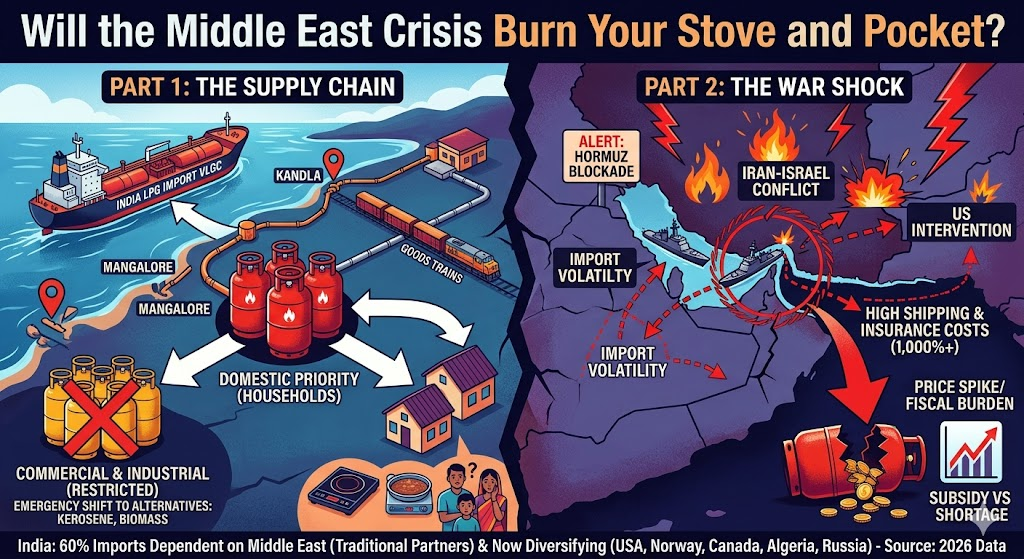
How LPG Travels from the Middle East to India
The journey of LPG from foreign countries to Indian homes involves several stages.
1. Transportation by Large Ships
LPG is converted into liquid form at extremely low temperatures and transported in massive LPG carrier ships.
2. Arrival at Indian Ports
These ships arrive at major Indian ports such as:
- Kandla Port (Gujarat)
- Mangalore Port (Karnataka)
3. Bottling Plants
From these ports, LPG is transported through pipelines, tankers, or railway wagons to bottling plants, where the gas is filled into cylinders.
4. Delivery to Homes
Finally, LPG cylinders are delivered to households through local gas agencies across the country.
How Middle East Conflicts Affect LPG Supply
Geopolitical tensions in the Middle East can disrupt LPG supply chains in several ways.
1. The Strait of Hormuz Shipping Route
A critical shipping route known as the Strait of Hormuz connects the Persian Gulf to global markets.
Most oil and gas shipments from the Middle East pass through this narrow waterway. If conflicts threaten or block this route, global energy supply chains can be disrupted.
This is one of the main reasons analysts discuss the Middle East war impact on LPG gas price in India whenever geopolitical tensions increase in the Gulf region.
2. Rising Shipping and Insurance Costs
Even when shipping routes remain open, conflicts increase transportation risks.
As a result:
- Insurance premiums for ships rise significantly
- Shipping companies increase freight charges
These additional costs increase the landing cost of LPG in India, which may eventually lead to higher gas cylinder prices.
3. Government Policy Challenges
When international LPG prices increase, the Indian government faces a difficult decision.
The government can either:
Increase LPG cylinder prices for consumers, or
Provide subsidies and absorb the cost.
Increasing prices can place financial pressure on households, especially under welfare schemes such as the Ujjwala Yojana.
On the other hand, maintaining subsidies increases the financial burden on the government.
Conclusion
India’s LPG supply is part of a global energy network. Although the country produces some LPG domestically, a large portion still comes from imports, particularly from Middle Eastern nations.
Because of this dependency, the Middle East war impact on LPG gas price in India can directly affect household expenses and national energy costs.
While India has started diversifying its imports by purchasing LPG from countries like the United States and Canada, the Middle East remains a major supplier. Therefore, stability in the region plays an important role in maintaining stable LPG prices for millions of Indian households.
Nice and very informative.